When does a smaller object inherit clearance?
Imagine that a bus has already passed safely through a tunnel. Can a smaller vehicle follow it?
The useful answer begins with what smaller means. Less mass, less volume, or a shorter length is not enough. The second vehicle must fit inside the first vehicle's relevant clearance envelope, after the models have been aligned, and it must be able to follow the same motion.
I call this containment observation Anagh's Law. The mathematics is elementary: applying the same map to two nested sets keeps them nested. The value of the formulation is in making the conditions easy to remember and the failure cases easy to notice. The formal note gives the precise statement; this article explains it through drawings and worked examples.
The drawings use two-dimensional models for readability. They are not engineering measurements of real vehicles. The same containment argument applies in three dimensions; the volume example below is obtained by giving both drawn rectangles a depth of one unit.
1. A successful check can cover more than one object
Let A be a containing envelope, B an envelope inside it, and S the available space. An envelope is the object's occupied region or a conservative region that encloses it. We compare A and B in a shared body coordinate system, then apply one common placement T to both.
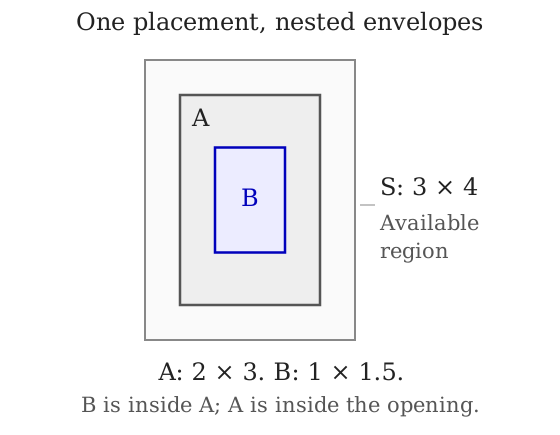
Figure 1. Every point of B is already a point of A. Certifying the outer envelope certifies the inner one at the same placement.
For a concrete example, take an opening that is 3 units wide and 4 units high. Center an axis-aligned 2-by-3 envelope A in it. A has 0.5 units of clearance on every side. A centered 1-by-1.5 envelope B lies inside A and has even more clearance: 1 unit horizontally and 1.25 units vertically.
The proof does not need these particular dimensions. If B ⊆ A, then T(B) ⊆ T(A). If T(A) lies in the interior of S, so does T(B):
B ⊆ A and T(A) ⊆ int(S) imply T(B) ⊆ T(A) ⊆ int(S).
This certifies a particular shared placement. If a support, orientation restriction, or other constraint prevents B from using that placement, the geometric inclusion alone does not provide physical feasibility.
In packaging, for example, an enclosing box might be certified for an opening once. Several product variants can inherit that result if each is contained in the box in the agreed frame and each admits the same handling motion. The benefit depends on verifying containment being easier than repeating the full clearance check.
2. Lower volume is a different comparison
Suppose A is 1 unit wide, 3 units high, and 1 unit deep. Let B be 0.5 units wide, 4 units high, and 1 unit deep. Their volumes are 3 and 2 cubic units respectively. B has less volume, but is taller.
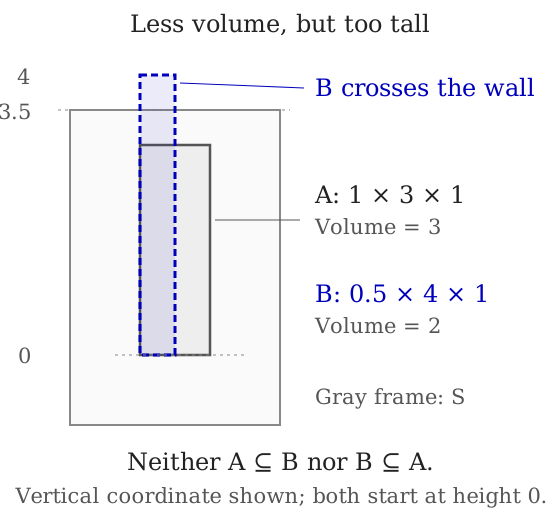
Figure 2. A has greater volume and clears this region. B has lower volume but crosses its upper boundary. Neither envelope contains the other.
Use the coordinates A = [0,1] × [0,3] × [0,1] and B = [0,0.5] × [0,4] × [0,1]. At the identity placement, A lies strictly inside S = [-1,2] × [-1,3.5] × [-1,2]. B does not: its points at height 4 are outside S.
The point (1,0,0) is in A but not B. The point (0,4,0) is in B but not A. These two witnesses show why containment is a partial order: some pairs are incomparable. A family can have a common enclosing envelope even when it has no largest member under inclusion.
If your argument uses only volume, width, height, length, or mass, the containment hypothesis has not yet been established.
3. Touching is not strict clearance
In the note, strict clearance means that the whole placed envelope lies in int(S), the interior of the available region. An envelope that touches a wall fails this condition, even if it is contained in a closed region S that includes the wall.
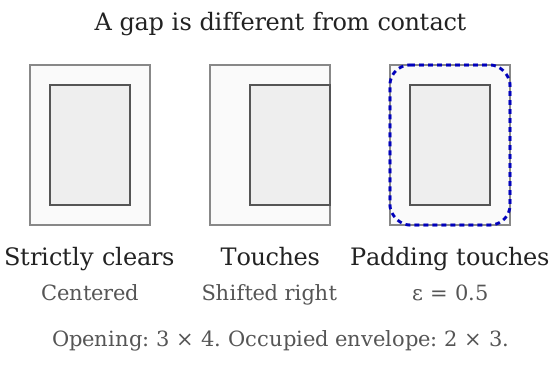
Figure 3. A gap, boundary contact, and a padded envelope are three distinct checks. Dashed outlines show padding, not additional occupied material.
A specified safety margin can be modeled by padding the envelope in every direction. Write Eε = E ⊕ B̄ε(0): the Minkowski sum of E with a closed ball of radius ε. This includes every point within distance ε of E. At a rectangle's corners, Euclidean padding is rounded, rather than a larger rectangle with square corners.
In the centered 2-by-3 example, the original minimum gap is 0.5 units. Padding by ε = 0.2 leaves a minimum gap of 0.3 units. Padding by ε = 0.5 touches the opening and fails strict clearance. With this convention, checking that the padded envelope lies strictly inside S reserves more than ε clearance; equality does not pass.
Common padding preserves inclusion: if B ⊆ A, then Bε ⊆ Aε. But two objects with different required margins need a comparison of their padded envelopes. A smaller occupied object with a much larger required margin need not inherit the other object's certificate.
4. An entrance check is not a path check
An object may fit at an entrance and collide farther inside. To transfer an entire motion, the outer envelope must clear at every point along that motion, and the motion must be admissible for both objects.
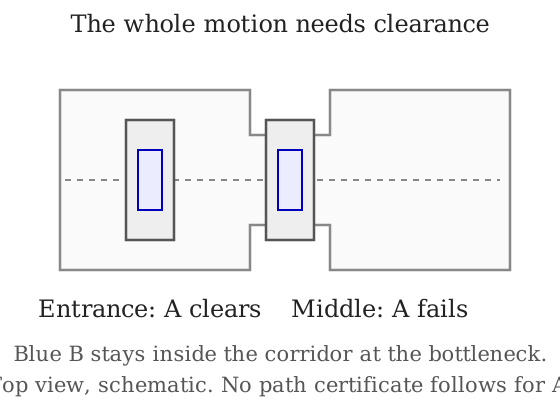
Figure 4. The entrance pose succeeds, but the outer envelope fails at the bottleneck. That failure tells us nothing conclusive about the contained envelope's success or failure.
For a path of placements Tₛ, with s running from 0 to 1, the required hypothesis is Tₛ(A) ⊆ int(S) for every s. Applying the same containment implication at each s then certifies B along the entire path. A few successful samples do not establish the condition between samples without an additional argument.
Steering, turning radius, ground support, and deformation require their own models. The statement does not supply a driving plan or certify a real tunnel crossing from a drawing.
5. Conservative bounds certify success
An enclosing box can be convenient to test. If the box clears, the geometry it encloses clears too. If the box fails, the geometry may still fit. A thin diagonal bar, for instance, occupies much less of its axis-aligned bounding box than the box itself; a narrow diagonal slot may admit the bar while rejecting the box.
The same reasoning also explains the direction of the implication. A contained envelope failing at a shared placement implies that its containing envelope fails there. A containing envelope failing does not imply that every contained object fails.
Before reusing a clearance result, establish containment in a shared frame, apply the same placement or motion, check that both objects admit it, and include the actual margin convention. Those are the facts doing the work.
Formal note and further reading
The mathematical note states the definitions, lemma, theorem, corollaries, and counterexample precisely. Its archived v1.1.0 edition includes the PDF and LaTeX source. The origin and naming account is separate from the mathematics.
For the broader geometric setting, see Steven M. LaValle's Planning Algorithms, Chapters 3–4. Gino van den Bergen's AABB-tree paper concerns hierarchical bounding boxes for collision detection; Gilbert, Johnson, and Keerthi's GJK paper concerns distances between convex sets. These are references for the geometric and computational context, not claims of novelty for the containment observation.
The model below lets you change a shared rotation, horizontal offset, and padding. Its verdicts are computed analytically for rectangles in a rectangular opening. It demonstrates a single placement; it does not test a continuous motion or model physical admissibility.
Try a shared placement
Opening: 3 × 4 units. A: 2 × 3. B: 1 × 1.5. Both share the same center, rotation, and padding.
A strictly clears. Signed remaining gap: 0.500 units.
B strictly clears. Signed remaining gap: 1.000 units.
A certifies B at this shared placement.
Positive gap passes; zero means contact; negative means a boundary is crossed. The values describe this planar rectangle model, not a physical vehicle or a path.